SP-TransientBench: A Real-Captured Single Photon Perception Benchmark (ECCV 2026)

Hongzhou Dong1, Zili Zhang1, Ziting Wen2, Yiheng Qiang1, Runrong Deng2, Wenle Dong1, Ziwen Jiang1, Xinyang Li1, Rui Lu1, Shuoyao Sun1, Wenyu Wang1, Ziyi Xia1, Haitao Zheng1, Guodong Shi3, Xiaoqiang Ren1
1Shanghai University, 2Southern University of Science and Technology, 3The University of Sydney

SP-TransientBench: a real-captured, multi-task benchmark for learning geometry and semantics directly from full single-photon LiDAR transient histograms.

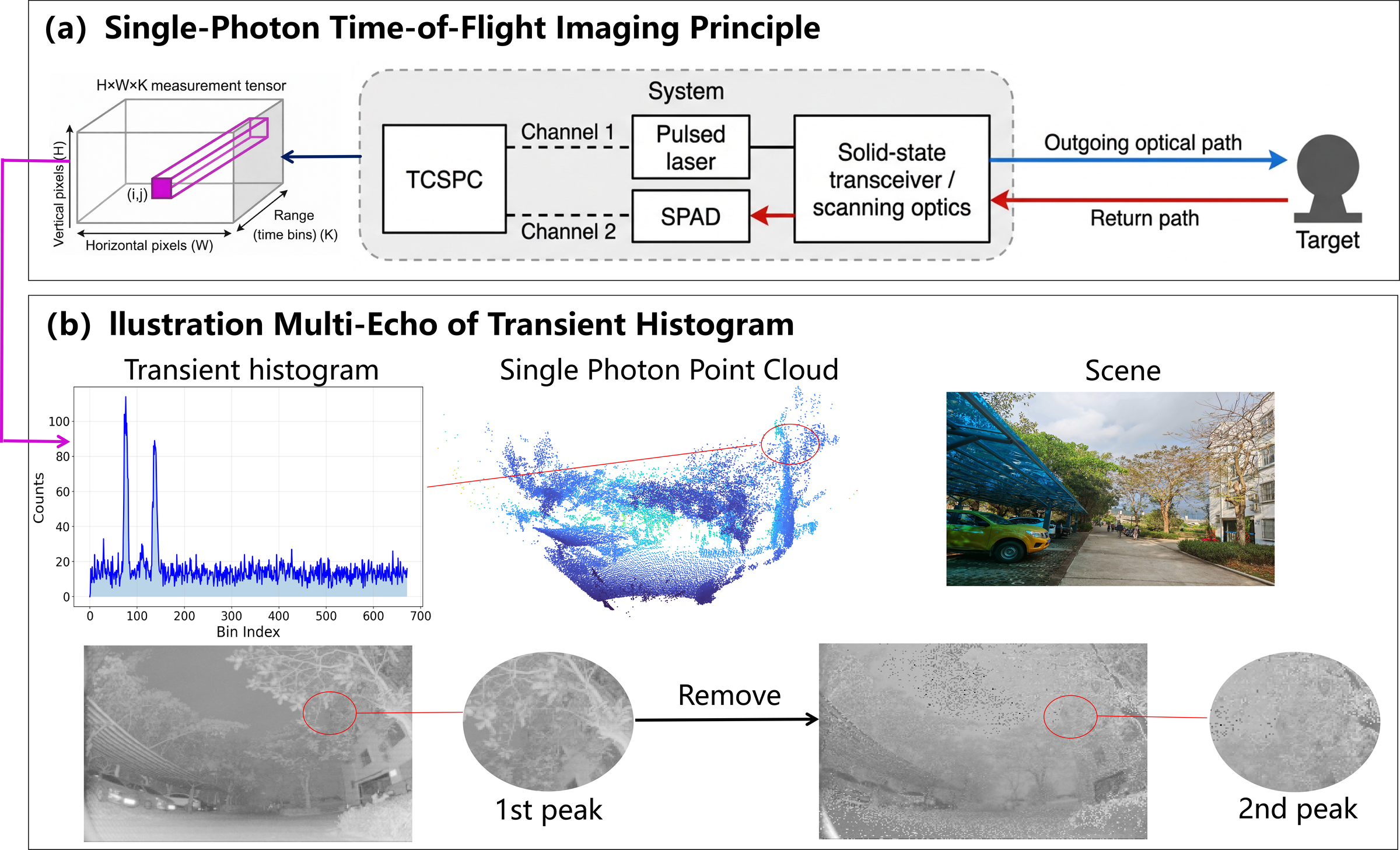
Single-photon LiDAR sensing pipeline and representative observations
Single-photon LiDAR sensing pipeline and representative real-captured observations. Each view preserves a full H × W × K transient tensor and multi-return structures.

Abstract

Single-photon LiDAR (SPL) based on single-photon avalanche diode sensing enables time-resolved photon measurements with extreme sensitivity, offering unique potential for active 3D perception. However, real-world single photon perception remains challenging because measurement noise and complex multi-return transient phenomena jointly complicate geometric reconstruction and semantic scene understanding. Existing studies are largely limited to simulated data or small-scale controlled captures.

We introduce SP-TransientBench (STB), a real-captured multi-task benchmark for single photon perception. STB provides full time-of-flight histograms, standardized metadata, calibrated camera poses, 13-class 3D semantic annotations, and histogram-domain multi-return annotations. Dedicated data splits and evaluation protocols enable consistent benchmarking across depth estimation, multi-view 3D reconstruction, and 3D semantic segmentation.
SP-TransientBench Dataset

STB contains three complementary real-captured subsets. Every view provides a full 256 × 192 × 672 SPAD histogram, resulting in approximately 168.7 GB of transient data.

10Depth estimation samples
9Multi-view scenes
27Semantic sequences
10,297Semantic samples
13Semantic classes
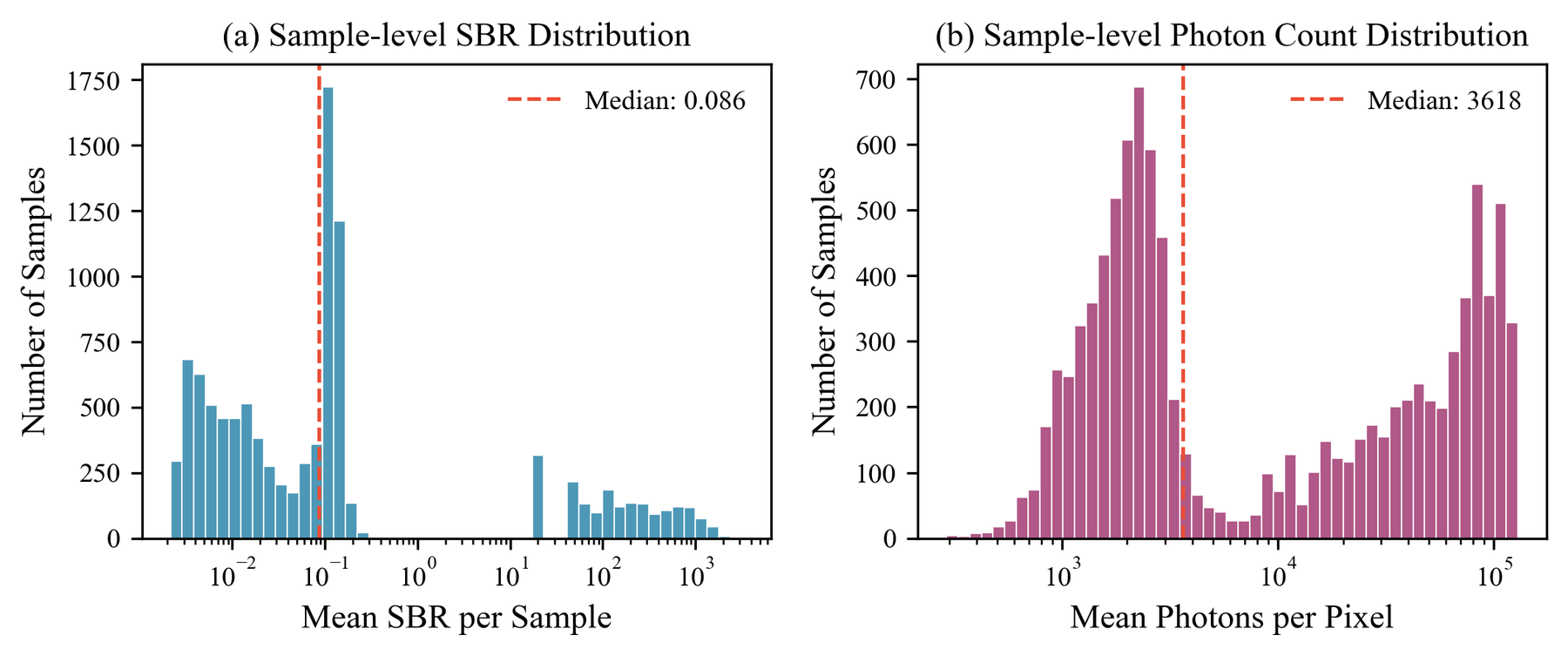
Signal-to-background ratio and photon-count distributions
Key sensing statistics, including sample-level signal-to-background ratio and mean photons per pixel. STB spans clean returns and strongly background-dominated photon regimes.

Histogram-Domain Multi-Return Annotation

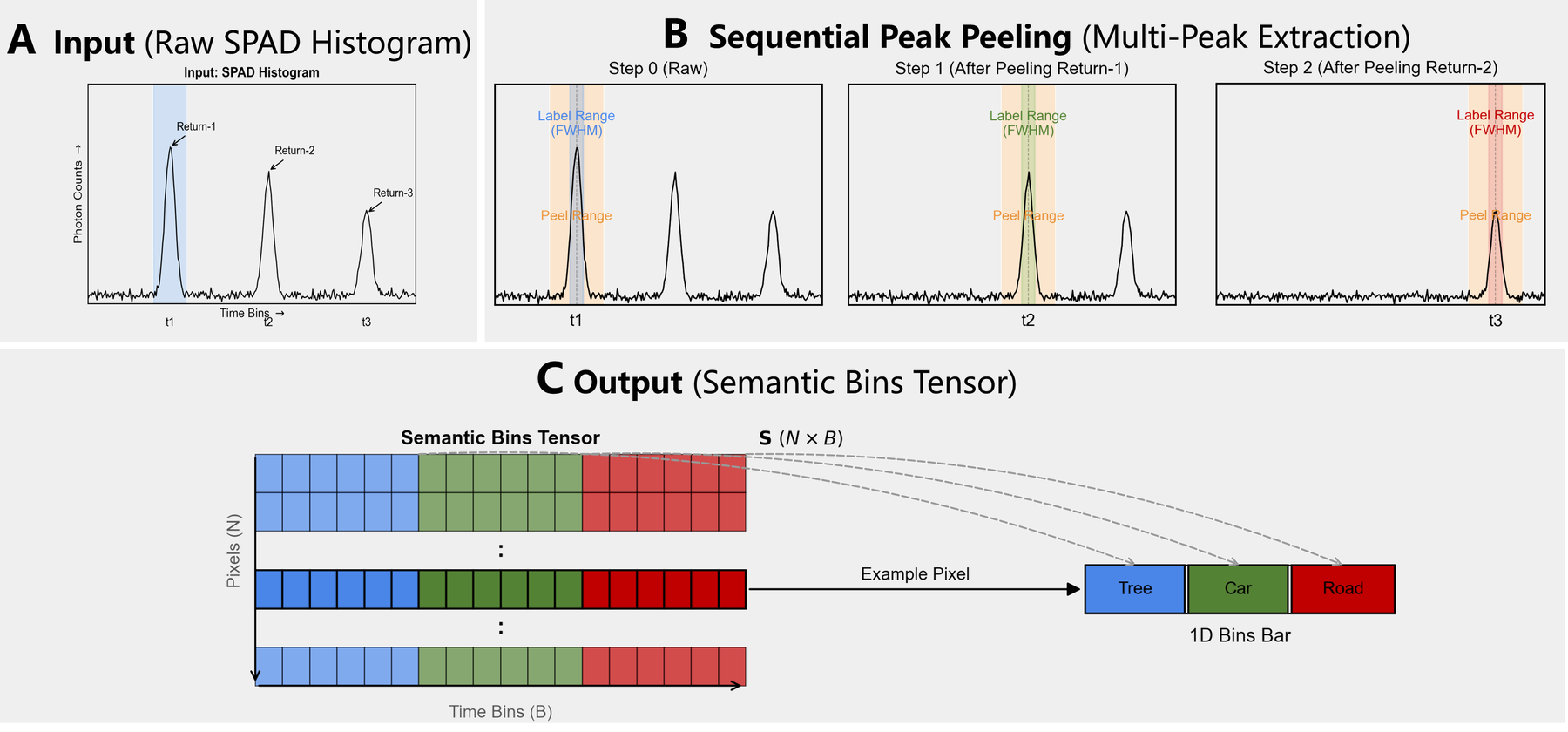
A single SPAD pixel may contain several temporally separated returns from different surfaces. Instead of assigning one label per pixel, STB represents semantic labels over temporal bins and uses sequential peak peeling to identify a dominant return, label its support interval, suppress it, and reveal weaker returns.

Sequential peak-peeling annotation pipeline
Sequential peak labeling for multi-return semantic bin annotations. A single pixel ray can encode multiple semantic entities at different ranges.

Benchmark Tasks

All benchmark experiments use SPAD-only inputs, without RGB guidance or RGB–SPAD fusion.

Task 1: Depth Estimation

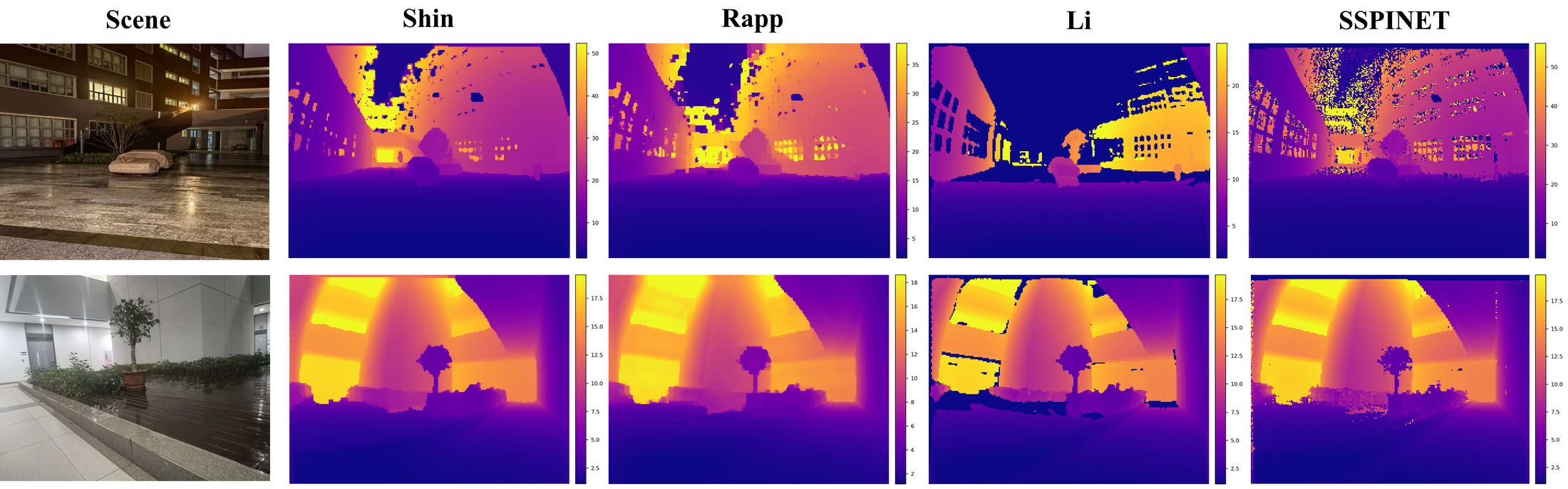
Depth is estimated directly from raw photon time-of-flight histograms and compared with Livox reference geometry using Chamfer Distance and Recall at 1-, 3-, and 5-bin temporal tolerances. Among the evaluated methods, SSPINET achieves the lowest CD of 1.4978 m and the highest Recall@5 of 93.68%.

Depth estimation qualitative comparison
Qualitative depth estimation results. Columns show the scene, ground truth, Shin, Rapp, Li, and SSPINET.

Task 2: Multi-View 3D Reconstruction

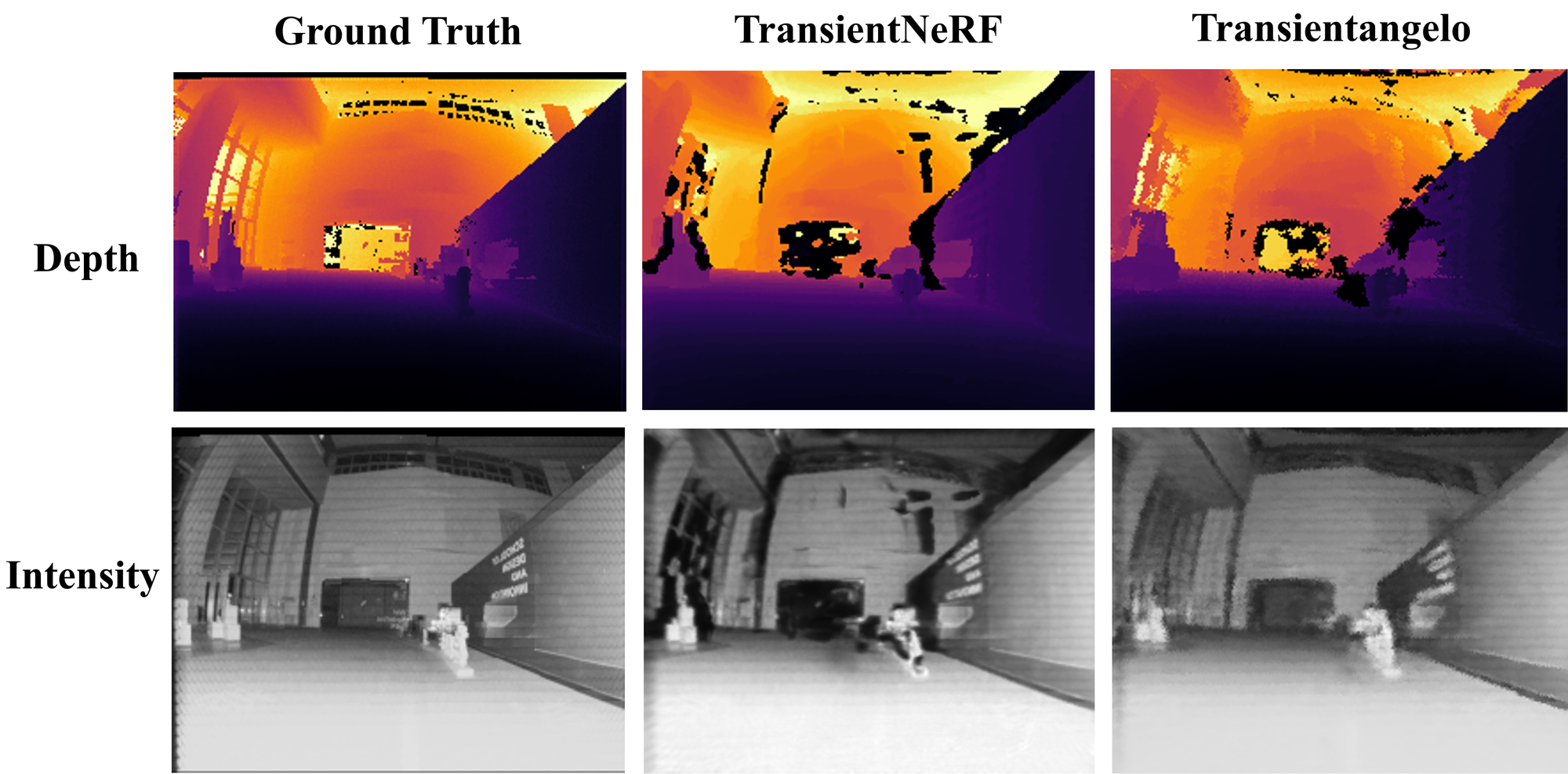
This track reconstructs geometry and renders novel views from calibrated transient observations. Experiments use 3, 5, or 10 input views and evaluate intensity with SSIM/LPIPS, depth with L1, and rendered histograms with PSNR. TransientNeRF obtains a histogram PSNR of 45.4251 dB in the reported 10-view setting.

Multi-view reconstruction qualitative comparison
Novel-view depth and intensity results from Ground Truth, TransientNeRF, and Transientangelo.

Task 3: 3D Semantic Segmentation

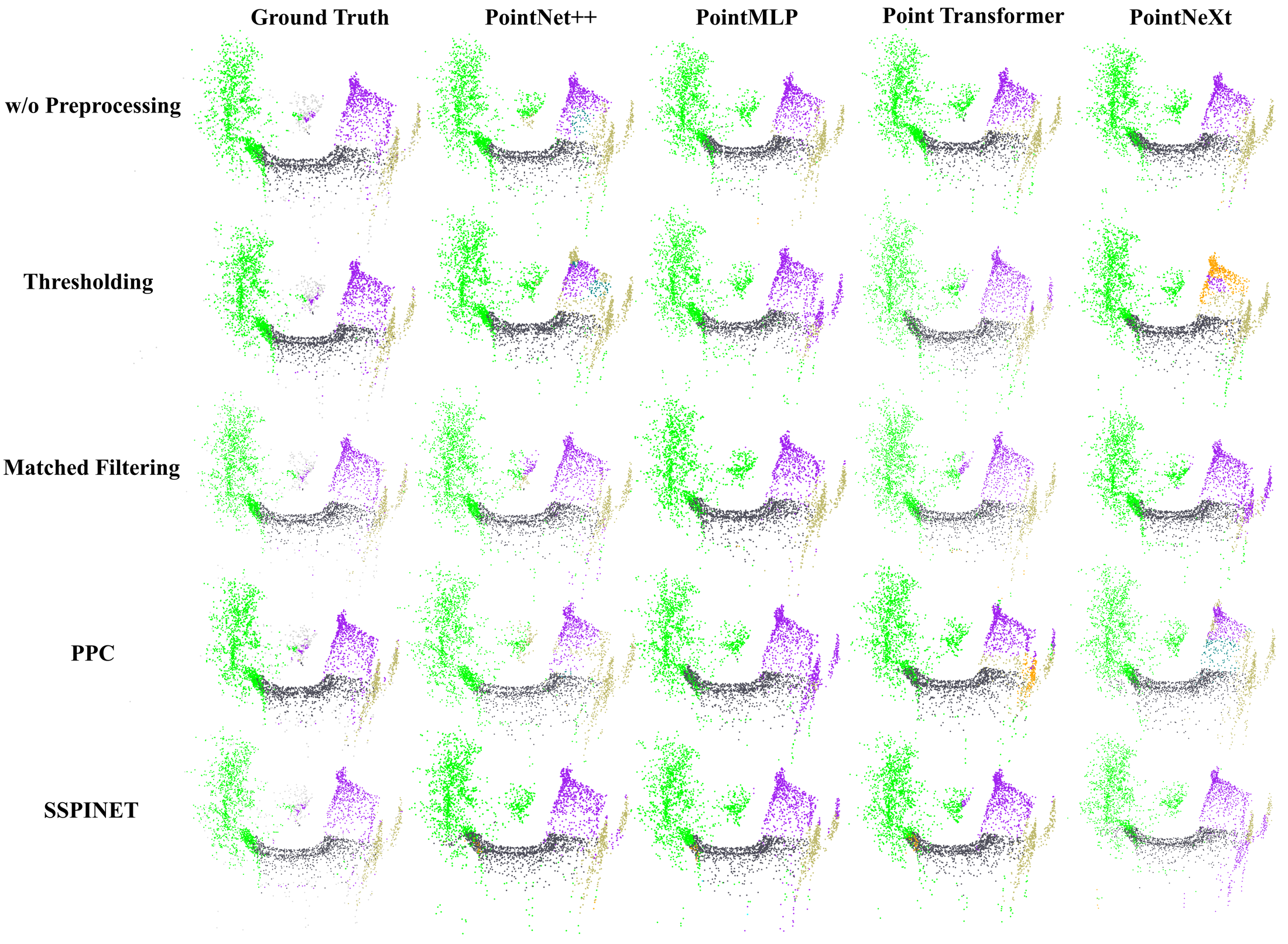
The semantic track combines histogram-domain preprocessing with PointNet++, PointMLP, Point Transformer, and PointNeXt. The official split contains 8,297 training samples and 2,000 test samples. Thresholding with PointMLP reaches 90.81% OA and 52.22% mIoU.

3D semantic segmentation qualitative comparison
Qualitative 3D semantic segmentation results for different transient preprocessing methods and point-cloud backbones.

Simulation-to-Real Gap

Simulation pretraining improves semantic segmentation when only limited real data are available, but its advantage diminishes as the amount of real training data increases. With the full training set, training from scratch is comparable or slightly better, showing that simulated transients cannot fully reproduce real sensor noise, multi-return effects, and photon statistics.

Citation

If you find SP-TransientBench useful in your research, please cite our paper.

@inproceedings{dong2026sptransientbench,
  title     = {SP-TransientBench: A Real-Captured Single Photon Perception Benchmark},
  author    = {Dong, Hongzhou and Zhang, Zili and Wen, Ziting and Qiang, Yiheng and Deng, Runrong and Dong, Wenle and Jiang, Ziwen and Li, Xinyang and Lu, Rui and Sun, Shuoyao and Wang, Wenyu and Xia, Ziyi and Zheng, Haitao and Shi, Guodong and Ren, Xiaoqiang},
  booktitle = {European Conference on Computer Vision (ECCV)},
  year      = {2026}
}